Mold Removal in Allen, TX
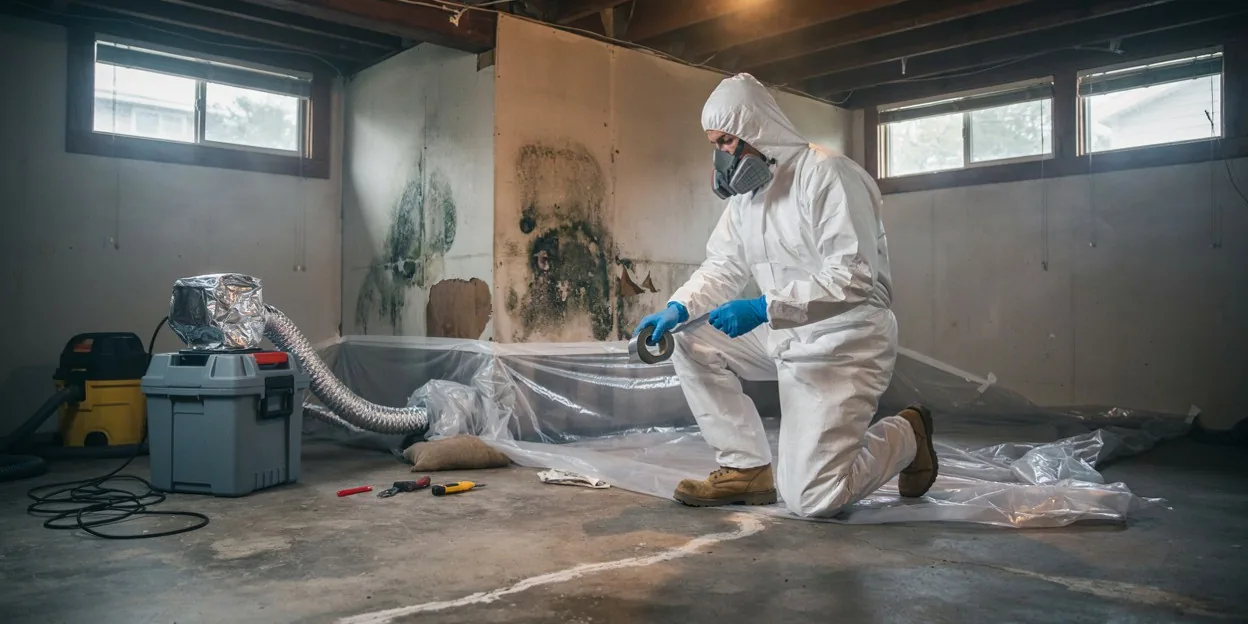
Allen sits directly north of Plano along Central Expressway, a Collin County town that held fewer than 20,000 people in 1990 and passed 100,000 by 2020. Almost everything in it was built in that stretch: two-story brick houses on post-tension slabs in Twin Creeks, Star Creek, and the subdivisions off Exchange Parkway, with the furnace and coil in the attic and PVC drains under the concrete. Blackland clay under those slabs swells every wet spring and shrinks every dry August, and the plumbing cast into the concrete moves with it.
That movement is why Allen mold calls start with a plumber. A hairline split in a supply line under the kitchen runs for a season before the pantry floor feels damp. The second source is overhead: the attic unit cycles all day in a 100-degree July, and a condensate line that clogs puts the drain pan's overflow onto the ceiling below. Allen also took two-inch hail on April 11, 2016, and roofs patched late that year fed decking stains through the following summer.
When an Allen homeowner calls this number, the call goes to an independent local mold provider. That company walks the house with a meter and lays out the scope; our part ends when the phone connects.
Allen mold removal under a 1998 slab and behind a 2006 attic unit
A damp pantry floor or a dark baseboard behind the fridge in a Twin Creeks two-story is mold removal, with the slab line found and fixed first. A tan ring on the hall ceiling under the attic access is HVAC mold cleaning at the pan and coil. A roof that lost shingles in the hail and dripped onto the decking for months is attic mold remediation.
Permits north of the Plano line
A rebuild that touches plumbing or electrical inside Allen runs through the City of Allen, not Plano, even for houses that share a fence with the Plano side of the line. The provider pulls it.
Call (972) 787-0657 and tell us what you see. We put you through to a local mold provider serving Allen.
Services Available in Allen
Mold Removal
Growth on drywall after a slab leak, a water heater, or a washer box let go: room sealed, wet board cut to the meter line, framing HEPA-cleaned and dried.
Black Mold Removal
A dark patch handled by how far the water traveled, not its color: containment up, porous material out, hard surfaces cleaned, the leak fixed before closing.
Whole-Home Mold Remediation
A slab leak that ran for months or a line that split in a freeze and soaked several rooms, mapped wall by wall and cleared in zones as one project.
HVAC Mold Cleaning
Coil, drain pan, and condensate line cleaned or replaced when the attic air handler sweats through a 100-degree Plano summer and drips into the ceiling below.
Bathroom Mold Removal
Growth behind a vanity, under a shower pan, or on a ceiling with a weak fan, removed after the supply line or the drain leak behind it is repaired.
Attic Mold Remediation
Growth on roof decking under hail-cracked shingles or around a sweating duct, cleaned and treated once the roof and the insulation are put right.
Mold Odor Removal
A musty smell in a house that looks fine, traced to the wet pad under the floor or the drywall behind a cabinet, then removed and treated.
Mold Damage Repair
Drywall, texture, baseboard, and cabinet bottoms put back after removal, once the slab reads dry and the plumber has fixed what started it.