Mold Removal in The Colony, TX
The Colony is a Denton County city on the east shore of Lewisville Lake, west of Plano across the Dallas North Tollway. It began in the 1970s as a single huge tract development of starter homes, incorporated in 1977, and most of the original city is still those 1970s and early 1980s one- and two-story frame houses with brick fronts on slabs. The newer neighborhoods along the tollway and around Grandscape are 2000s and 2010s brick two-stories with attic air handlers.
The original tract houses are now forty-five to fifty years old, and their slab plumbing has moved with the clay for all of it. Water heaters in garages and hall closets have been replaced twice, washer boxes have dripped inside walls, and hall bath fans vent into attics. The lake adds humidity to the summer air, and the newer houses see the standard condensate overflow from an attic unit running all day in July.
Homeowners in The Colony who call reach an independent local mold provider, who meters the house and explains the scope. The call is our part; the inspection, the work, and the contract are the provider's.
Mold removal in a 1978 tract house or a 2015 two-story by the lake
A soft baseboard behind a garage water heater or a dark wall behind the washer in an original tract house is mold removal. A hall bath whose grout blackens every month and whose fan ends in the attic is bathroom mold removal. A ceiling ring under the attic unit in a newer house is HVAC mold cleaning.
City Hall and the Corps lake next door
Rebuilds that touch plumbing or electrical are permitted through The Colony, and the provider handles that. The city's western edge is Lewisville Lake, the Corps of Engineers reservoir that holds back the Elm Fork of the Trinity and keeps the lakefront humid long after Plano has dried out.
Call (972) 787-0657 and tell us what you see. We put you through to a local mold provider serving The Colony.
Services Available in The Colony
Mold Removal
Growth on drywall after a slab leak, a water heater, or a washer box let go: room sealed, wet board cut to the meter line, framing HEPA-cleaned and dried.
Black Mold Removal
A dark patch handled by how far the water traveled, not its color: containment up, porous material out, hard surfaces cleaned, the leak fixed before closing.
Whole-Home Mold Remediation
A slab leak that ran for months or a line that split in a freeze and soaked several rooms, mapped wall by wall and cleared in zones as one project.
HVAC Mold Cleaning
Coil, drain pan, and condensate line cleaned or replaced when the attic air handler sweats through a 100-degree Plano summer and drips into the ceiling below.
Bathroom Mold Removal
Growth behind a vanity, under a shower pan, or on a ceiling with a weak fan, removed after the supply line or the drain leak behind it is repaired.
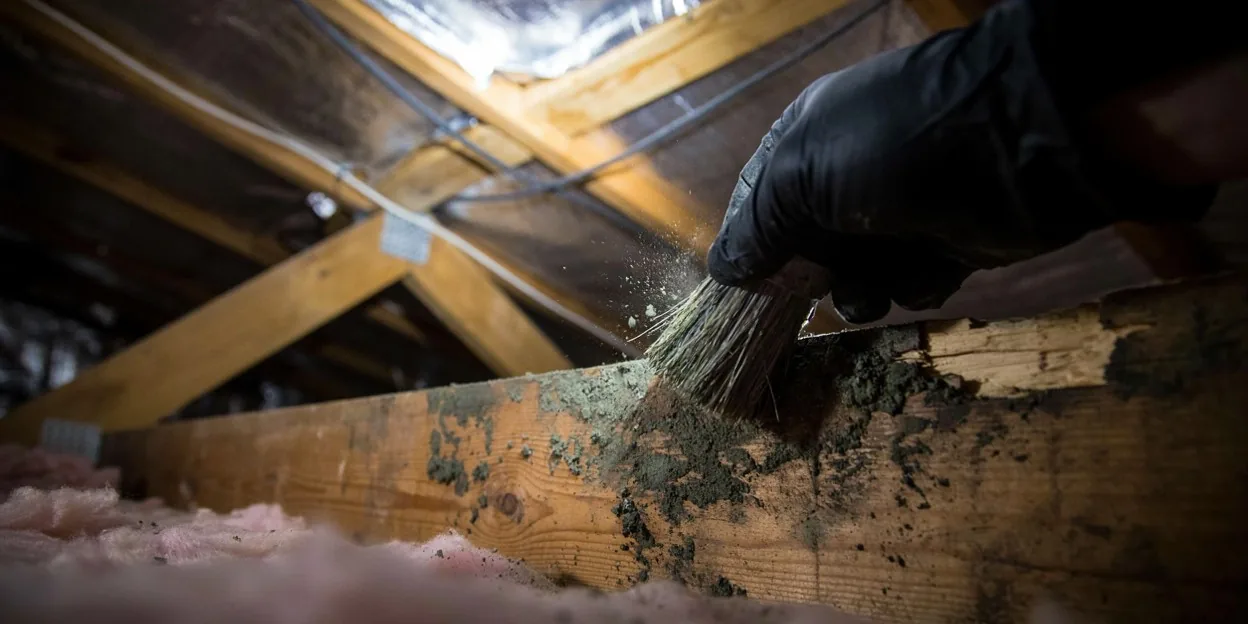
Attic Mold Remediation
Growth on roof decking under hail-cracked shingles or around a sweating duct, cleaned and treated once the roof and the insulation are put right.
Mold Odor Removal
A musty smell in a house that looks fine, traced to the wet pad under the floor or the drywall behind a cabinet, then removed and treated.
Mold Damage Repair
Drywall, texture, baseboard, and cabinet bottoms put back after removal, once the slab reads dry and the plumber has fixed what started it.