Mold Removal in Fairview, TX
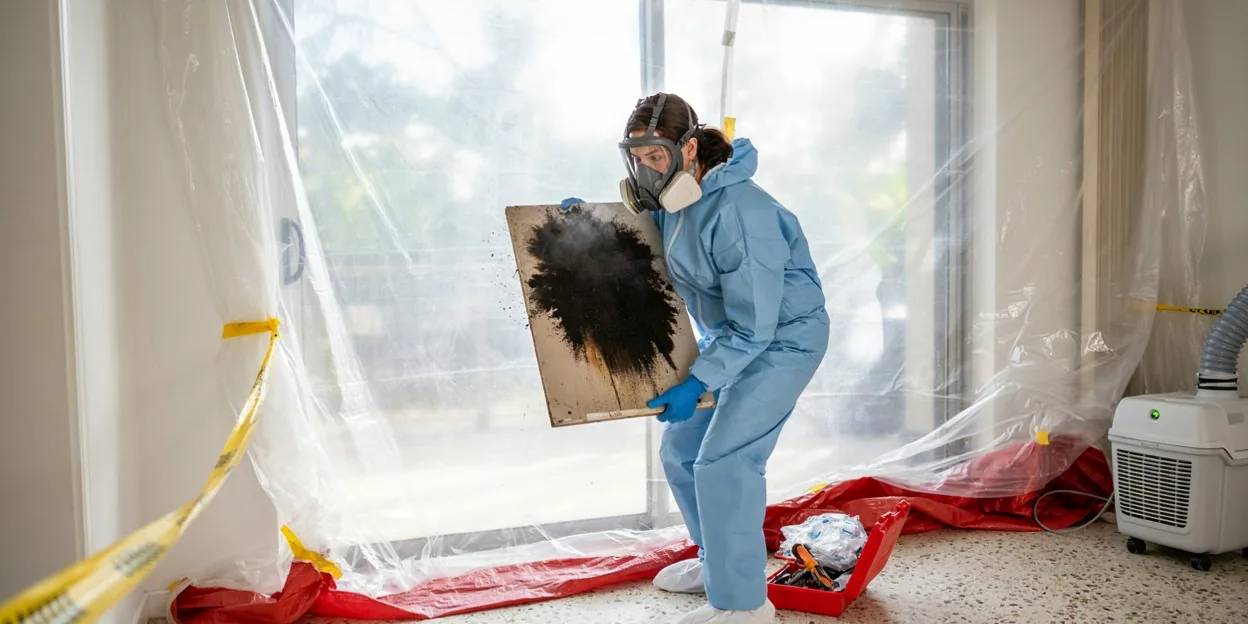
Fairview lies between Allen and McKinney along Central Expressway, a Collin County town that has held onto acre lots and open pasture while its neighbors filled in. Most houses are 1980s through 2010s custom homes on slabs set well back from the road, many on septic systems, with long yard lines from the meter, sprinkler systems across an acre of clay, and the attic air handler that every North Texas house built after 1990 seems to have. The newer mixed-use area near the expressway adds townhomes and condos.
Acre lots change the leak list. A yard line that breaks near the foundation keeps one side of the slab wet for a season. A septic spray field too close to the house does the same thing after a wet spring. Inside, the standard pattern holds: Blackland clay moves, a slab line cracks, and a hall closet smells like a creek bed before anything shows. Fairview roofs also take hail most springs, and a roof patched late puts water on the decking all summer.
Fairview homeowners who use this number reach an independent local mold provider. That company meters the house, writes the scope, and does the work; we handle the phone call only.
Fairview mold removal on an acre of Blackland clay
A wet garage wall or utility room where the yard line enters is mold removal, traced to the line first. Dark decking and matted insulation under a hail-damaged roof is attic mold remediation. A musty smell in a house that looks fine is mold odor removal, and on an acre lot the crew checks the yard line and the septic side of the house before the slab.
The town hall and the 289-acre sanctuary
Rebuilds inside the town are permitted through the Town of Fairview. Just across the McKinney line sits the Heard Natural Science Museum and Wildlife Sanctuary, 289 acres of Blackland prairie and bottomland that show what the ground under every Fairview slab looked like before the houses came.
Call (972) 787-0657 and tell us what you see. We put you through to a local mold provider serving Fairview.
Services Available in Fairview
Mold Removal
Growth on drywall after a slab leak, a water heater, or a washer box let go: room sealed, wet board cut to the meter line, framing HEPA-cleaned and dried.
Black Mold Removal
A dark patch handled by how far the water traveled, not its color: containment up, porous material out, hard surfaces cleaned, the leak fixed before closing.
Whole-Home Mold Remediation
A slab leak that ran for months or a line that split in a freeze and soaked several rooms, mapped wall by wall and cleared in zones as one project.
HVAC Mold Cleaning
Coil, drain pan, and condensate line cleaned or replaced when the attic air handler sweats through a 100-degree Plano summer and drips into the ceiling below.
Bathroom Mold Removal
Growth behind a vanity, under a shower pan, or on a ceiling with a weak fan, removed after the supply line or the drain leak behind it is repaired.
Attic Mold Remediation
Growth on roof decking under hail-cracked shingles or around a sweating duct, cleaned and treated once the roof and the insulation are put right.
Mold Odor Removal
A musty smell in a house that looks fine, traced to the wet pad under the floor or the drywall behind a cabinet, then removed and treated.
Mold Damage Repair
Drywall, texture, baseboard, and cabinet bottoms put back after removal, once the slab reads dry and the plumber has fixed what started it.