Mold Removal in Dallas North Estates, TX
Dallas North Estates was Plano's first big subdivision, named in 1959 by developer Herbert Hunt, who reasoned that nobody outside Collin County knew where Plano was. It spreads west of Central Expressway along 15th Street and Custer Road, and its centerpiece, the Texas Pool, opened in 1961 shaped like the state. The houses are 1960s brick ranches, mostly one story, on some of the earliest slabs poured in the city, with copper supply lines and cast iron drains cast into the concrete and the furnace in a hall closet.
Sixty years of Blackland clay movement under a 1960s slab is the whole story here. Cast iron drains have rusted thin and separated at joints, copper lines have cracked at fittings, and many houses have already had the supply rerouted overhead. The ones that have not make the classic slow call: a hall closet or a pantry that smells like wet earth with nothing showing, a soft baseboard behind the refrigerator, a hall bath whose floor gives at the toilet. The closet furnace adds its own drip when the condensate line clogs.
Dallas North Estates homeowners who call reach an independent local mold provider who meters the house and writes the scope. We connect the call; the inspection, the work, and the contract are the provider's.
Mold removal under one of Plano's first slabs
A pantry or hall closet that smells of damp earth is mold removal, with the cast iron drain and the copper traced by a plumber first. A hall bath floor gone soft at the toilet is bathroom mold removal. A wet carpet pad that runs from the hall into two bedrooms before anyone noticed is whole-home mold remediation.
The hospital on 15th Street
Medical City Plano, a 603-bed hospital with a Level I trauma center, sits on West 15th Street at the neighborhood's western edge and is the nearest emergency room for most of central Plano.
Call (972) 787-0657 and tell us what you see. We put you through to a local mold provider serving Dallas North Estates.
Services Available in Dallas North Estates
Mold Removal
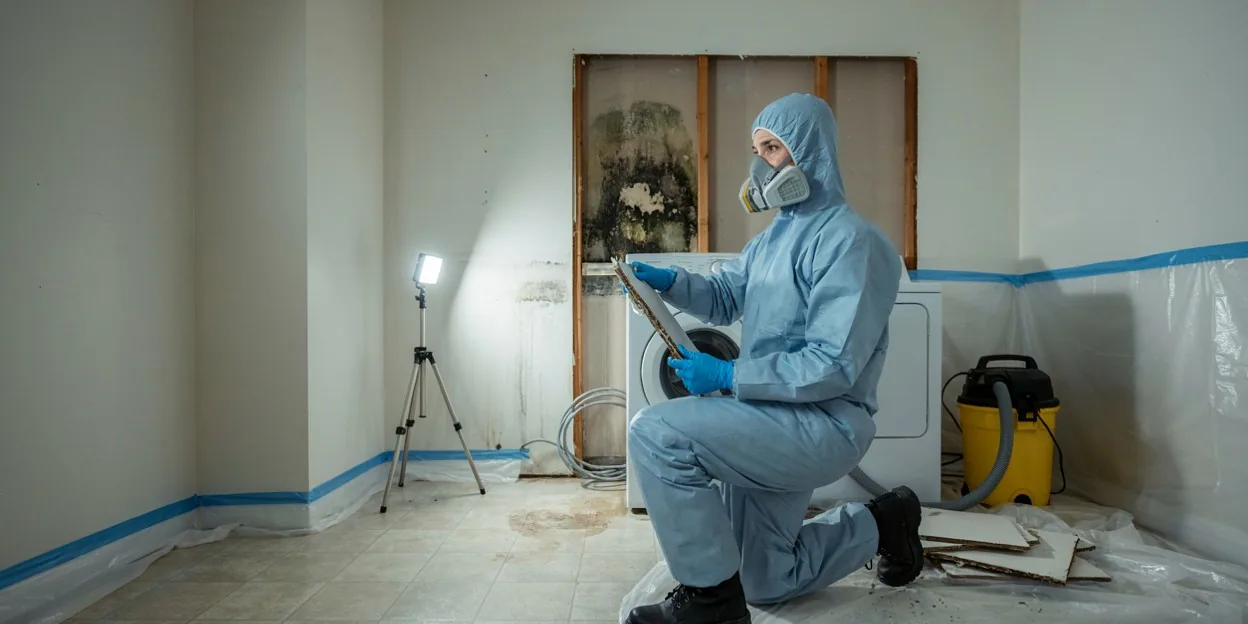
Growth on drywall after a slab leak, a water heater, or a washer box let go: room sealed, wet board cut to the meter line, framing HEPA-cleaned and dried.
Black Mold Removal
A dark patch handled by how far the water traveled, not its color: containment up, porous material out, hard surfaces cleaned, the leak fixed before closing.
Whole-Home Mold Remediation
A slab leak that ran for months or a line that split in a freeze and soaked several rooms, mapped wall by wall and cleared in zones as one project.
HVAC Mold Cleaning
Coil, drain pan, and condensate line cleaned or replaced when the attic air handler sweats through a 100-degree Plano summer and drips into the ceiling below.
Bathroom Mold Removal
Growth behind a vanity, under a shower pan, or on a ceiling with a weak fan, removed after the supply line or the drain leak behind it is repaired.
Attic Mold Remediation
Growth on roof decking under hail-cracked shingles or around a sweating duct, cleaned and treated once the roof and the insulation are put right.
Mold Odor Removal
A musty smell in a house that looks fine, traced to the wet pad under the floor or the drywall behind a cabinet, then removed and treated.
Mold Damage Repair
Drywall, texture, baseboard, and cabinet bottoms put back after removal, once the slab reads dry and the plumber has fixed what started it.